What Are Managed Security Services? Complete Guide for 2026

Managed Security Services: Key Takeaways
- Managed IT security services provide continuous monitoring, rapid detection, and expert analysis that internal teams often cannot sustain.
- As cyber threats advance, managed security services help organizations strengthen posture with round-the-clock oversight and faster response.
- Managed network security services protect core infrastructure, support compliance, and reduce risk for regulated and cloud-driven environments.
What Are Managed Security Services?
Cybersecurity threats continue to rise in speed and sophistication, and organizations are struggling to maintain the visibility and control needed to stay ahead.
Thank you for reading this post, don't forget to subscribe!According to Gartner, 90% of non-executive board-of-directors members lack confidence in the value their organizations receive from cybersecurity investments.
This signals a growing gap between what leadership expects and what internal teams can realistically deliver with existing resources.
This disconnect ties directly to the rise of managed security services. Boards want clearer outcomes. Executives want measurable resilience. Security teams want support that reduces noise so they can focus on strategic priorities.
Managed services fulfill that need by providing continuous monitoring, expert threat detection, operational transparency, and evidence that cybersecurity investments are delivering real business value.
After reading this guide, you will understand:
- What managed security services are and how they work
- The capabilities included in managed IT security services
- How managed network security services help organizations maintain resilience
- Why companies across industries are shifting toward managed security systems partnerships
- What to consider when selecting a managed security provider
At ISSGLOBAL, we help organizations close this visibility and confidence gap. Our advisory-driven approach simplifies complexity and provides leaders with the insights they need to understand exposure, reduce risk, and make informed decisions about their security posture.
A Simple Definition of Managed Security Services
Managed security services are outsourced cybersecurity operations provided by a managed security services provider.
The MSSP monitors, detects, investigates, and responds to threats across an organization’s digital environment, including networks, cloud infrastructure, endpoints, and identities.
Organizations rely on managed IT security services for:
- 24/7 monitoring
- Threat detection and alert triage
- Incident response and containment
- Vulnerability scanning and remediation guidance
- Endpoint and cloud security
- Identity and access oversight
- Managed network security services such as firewalls and intrusion detection
- Compliance reporting and audit support
These services reduce the daily operational burden on internal teams while improving accuracy, visibility, and readiness.
Why Organizations Need Managed Security Services Today
Threat actors use automation, credential theft, and social engineering to bypass traditional tools and overwhelm lean security teams.
The gap between attacker capability and internal resources grows wider each year.
Research from IBM’s 2025 Cost of a Data Breach Report shows that organizations with fully deployed security automation and managed detection capabilities reduce breach impact by an average of $1.76 million.
The need for continuous detection is further supported by data, highlighting that 83% of breaches involve external actors and often exploit preventable configuration or identity weaknesses.
This is why organizations across industries rely on managed security services:
1. Nonstop Security Monitoring
Threats can emerge at any moment. Continuous monitoring reduces dwell time and improves response.
2. Access to Specialized Talent
Threat hunters, analysts, cloud engineers, and compliance experts remain scarce. Managed IT security services provide immediate access to these roles.
3. Faster Detection and Response
Rapid containment limits impact. MSSPs guide isolation, investigation, and recovery.
4. Reduced Operational Burden
Alert fatigue and maintenance overwhelm IT teams. MSSPs streamline daily operations.
5. Stronger Compliance Readiness
Frameworks such as SOC 2, ISO 27001, HIPAA, PCI DSS, and NIST require ongoing oversight. Managed security services help maintain evidence, documentation, and continuous monitoring.
What MSSPs Do: Core Capabilities and Service Areas
Managed security services provide a broad spectrum of cybersecurity capabilities designed to help organizations reduce risk and maintain resilience. offer a broad range of cybersecurity capabilities, including:
1. Threat Monitoring and Detection
MSSPs analyze log data, user activity, and system behavior to surface anomalies and potential threats using advanced analytics.
2. Managed Network Security Services
Managed network security services improve perimeter defenses and limit lateral movement.
Capabilities include:
- Firewall management
- Intrusion detection and prevention
- VPN oversight
- Network segmentation
- Zero trust enforcement
3. Incident Response and Containment
MSSPs help isolate affected systems, evaluate impact, and guide response actions that limit downtime.
4. Vulnerability and Patch Management
Continuous scanning identifies exploitable weaknesses. MSSPs provide prioritized remediation guidance.
5. Endpoint Detection and Response
EDR tools detect malicious processes, suspicious movement, and unauthorized access across endpoint devices.
6. Cloud Security Monitoring
MSSPs monitor cloud permissions, misconfigurations, and identity behavior across multi-cloud environments.
7. Governance, Risk, and Compliance Support
Support includes audit documentation, evidence collection, and continuous oversight aligned with industry standards.
MSS vs. In-House Security Teams: Key Differences
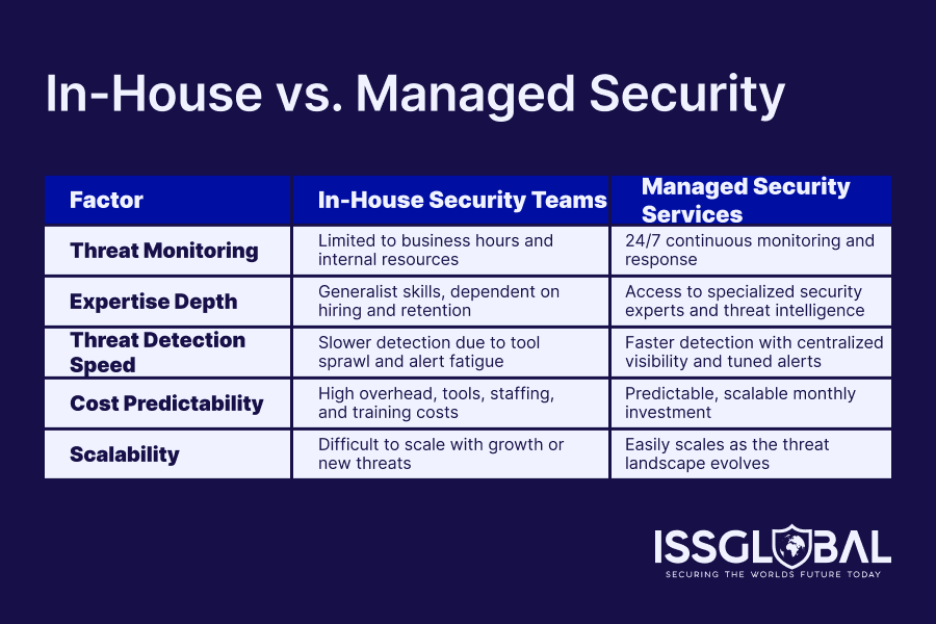
Internal teams understand organizational context, but MSSPs bring scale, specialized skills, and continuous monitoring that most teams cannot maintain. The benefits of outsource managed security services include:
Cost Efficiency
Hiring across all security disciplines is costly. Managed IT security services provide predictable coverage at a fraction of the cost.
Breadth of Expertise
Security spans cloud, identity, detection, compliance, and more. MSSPs provide multidisciplinary talent.
24/7 Readiness
Few internal teams can sustain nonstop monitoring and response.
Advanced Technology
MSSPs use enterprise grade analytics, detection platforms, and automation to improve accuracy.
Scalability and Flexibility
As organizations grow, MSSPs scale support without additional hiring or infrastructure.
Industries That Benefit Most From Managed Security Services
Organizations across regulated and high growth industries rely on managed security services to reduce risk and maintain resilience.
Industries include:
SaaS and Technology
Protects cloud native environments, user data, and multi-tenant architectures.
Financial Services
Supports fraud prevention, identity protection, and regulatory compliance.
Healthcare and HealthTech
Safeguards patient data and aligns with HIPAA security requirements.
Government and Defense Contractors
Supports NIST 800 171, CMMC, FISMA, and federal cybersecurity mandates.
Manufacturing, Energy, and Critical Infrastructure
Protects operational technology and distributed industrial networks.
How to Choose the Right Managed Security Services Provider
Selecting the right MSSP ensures your security program matures effectively and remains adaptable. Organizations should evaluate providers based on the following criteria:
1. Expertise Across Security Domains
Look for experience across detection, cloud security, compliance, and managed network security services.
2. Continuous Operations
Effective detection requires 24/7 monitoring.
3. Clear Documentation and Processes
Providers should outline communication workflows, reporting, and escalation paths.
4. Technology Compatibility
Your MSSP should integrate with existing tools rather than force replacements.
5. Transparent Reporting
Organizations should receive regular insights, metrics, and compliance documentation.
6. Partnership Mindset
Your MSSP should act as a strategic partner supporting long-term security maturity.
Managed Security Services: FAQs
1. What are managed security services in simple terms?
They are outsourced cybersecurity operations that provide round the clock monitoring, detection, and incident response.
2. What do managed IT security services include?
They include threat detection, incident response, vulnerability management, endpoint and cloud protection, and compliance support.
3. Why do companies hire an MSSP instead of building in house security?
MSSPs provide specialized expertise, advanced technology, and continuous monitoring that internal teams often cannot sustain.
4. What are managed network security services?
They include firewall management, intrusion detection, VPN oversight, network segmentation, and zero trust enforcement.
5. How do managed security services improve compliance?
They support evidence collection, documentation, control monitoring, and readiness for audits across standards such as SOC 2, ISO 27001, HIPAA, and NIST.