SOC 2 Type 2 in 6 Months: The Fast Path for SaaS Companies

SOC 2 Type 2: Key Takeaways
- A six-month SOC 2 Type 2 is only achievable when readiness work is complete before the observation period begins.
- The observation window has a three-month minimum, but most auditors recommend six months, and many enterprise customers expect 12.
- First-year SOC 2 programs typically cost from $30,000 to $150,000, with the audit accounting for only 40% to 60% of the total investment.
- You don’t need a signed auditor engagement letter to begin the observation window, and waiting for one can delay certification by six to eight weeks.
- Over-scoping the Trust Services Criteria creates more unnecessary delays than almost any other planning decision.
- SOC 2 renewals typically take three to five months and cost 30% to 50% less than the initial certification.
Third parties were involved in 48% of confirmed data breaches in 2026, according to Verizon’s annual Data Breach Investigations Report. Two years earlier, that figure was just 15%.
The change isn’t in your software but in how enterprise buyers evaluate risk.
As third-party risk has grown, procurement teams have moved away from trust-based assessments.
A SOC 2 Type 2 report increasingly determines whether your business moves straight into technical evaluation or stalls behind a lengthy security questionnaire.
Most SaaS companies take 12 to 18 months to achieve SOC 2 Type 2. Those that finish in six aren’t cutting corners or hiring a faster auditor.
They succeed because they sequence the work differently, and that difference is established long before the observation window begins.
How Long Does a SOC 2 Type 2 Actually Take?
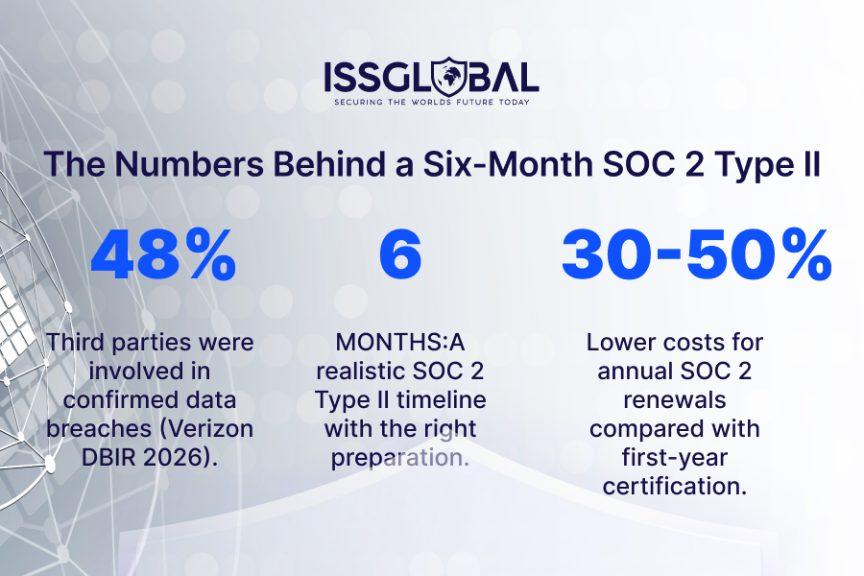
A first SOC 2 Type 2 typically takes six to 12 months from kickoff to the final report. Six months is achievable, but only when readiness is complete before the observation window begins, the scope is limited to the Security Trust Services Criteria, and remediation is finished early.
You’ll see it written as both SOC 2 Type II and SOC 2 Type 2. The terms are interchangeable and refer to the same report.
Renewals move faster, typically taking three to five months, because the controls are already operating and evidence collection is part of day-to-day processes.
Here’s what a six-month path looks like when it works.
| Month | What Happens | Key Deliverable |
| Month 1 | Define the audit boundary, run the readiness assessment, inventory existing controls | Gap report and prioritized remediation roadmap |
| Month 2 | Remediate gaps, write policies, configure technical controls, stand up evidence collection | Approved policy set and operational controls |
| Month 3 | Penetration test completes, controls go live, observation window opens (month 1 of 3) | Pen test report and documented window start date |
| Month 4 | Observation window, month 2 of 3: access reviews, change approvals, training completions | Continuous evidence log |
| Month 5 | Observation window, month 3 of 3: incident handling, vendor reviews, control drift monitoring. Window closes | Complete evidence package |
| Month 6 | Auditor fieldwork, testing, report drafting | SOC 2 Type 2 report |
One caveat: a six-month timeline assumes the audit is scheduled early. Because fieldwork typically takes four to eight weeks, auditors should be engaged by month 2 if you want the final report issued by month 6. Delay the engagement, and the report is likely to slip into month 7.
The timeline doesn’t depend on an unusually large budget or a lenient auditor. It depends on completing readiness, remediation, and evidence collection before each phase begins. That’s where SOC 2 compliance services make the difference.
Why Do Most SaaS Companies Take 12 to 18 Months?
Do the math before deciding compliance can wait another quarter.
A $500,000 annual contract sitting in security review for six extra months delays roughly $250,000 in revenue. That’s more than the cost of many first-year SOC 2 programs, and the report then supports every deal that follows.
So why do timelines stretch from six months to 12 or even 18? Four reasons, and none of them have much to do with the audit.
Ownership gets spread across engineering, security, and whoever answered the last customer questionnaire. Readiness becomes a paperwork exercise instead of a controls exercise.
Remediation slips behind the product roadmap. And companies wait for an auditor before starting an observation window that could have opened months earlier.
What Does a SOC 2 Type 2 Audit Cost in 2026?
A first-year SOC 2 Type 2 program typically costs between $30,000 and $150,000. The audit itself usually accounts for only 40% to 60% of that investment, which is why budgets based solely on the auditor’s fee often fall short.
For most SaaS companies with fewer than 50 employees and a Security-only scope, a realistic first-year budget falls between $30,000 and $50,000.
| Scope | Typical Audit Fee* | First-Year Total* | Observation Window | Best For |
| SOC 2 Type I | $5,000-$20,000 | $15,000-$40,000 | None (point in time) | A bridge document while Type II runs |
| Type II, first audit, Security only, under 50 employees | $15,000-$45,000 | $30,000-$50,000 | 3 to 6 months | Most SaaS companies on a six-month path |
| Type II, mid-market, two or three criteria | $30,000-$75,000 | $50,000-$100,000 | 6 to 12 months | Companies with regulated buyers |
| Type II, enterprise, multi-criteria, Big Four firm | $100,000+ | $100,000+ | 12 months | Public companies and large platforms |
The audit fee is only part of the budget. Four additional costs catch many teams by surprise.
A readiness assessment typically costs $5,000 to $25,000 and helps identify gaps before the observation window begins.
A penetration test generally ranges from $8,000 to $25,000 for a standard SaaS environment, and many enterprise buyers expect to review the results alongside your SOC 2 report.
You’ll also need to budget for compliance automation software and internal engineering time, which is often the largest cost despite never appearing on an invoice.
Costs fall significantly after the first year. Renewal programs typically cost 30% to 50% less because the policies, controls, and evidence collection processes are already in place.
What Are the SOC 2 Requirements You Have to Meet First?
SOC 2 doesn’t prescribe a fixed set of controls. Instead, the AICPA publishes the Trust Services Criteria, and each organization designs controls that meet those requirements. That’s why two SaaS companies of the same size can achieve SOC 2 compliance with different security programs.
The criteria are defined in the 2017 Trust Services Criteria, with updated points of focus released in 2022. They include five categories: Security, Availability, Processing Integrity, Confidentiality, and Privacy.
Security is the only mandatory category. It includes the Common Criteria (CC1 through CC9), which cover governance, risk assessment, logical and physical access, system operations, change management, and risk mitigation.
The remaining four categories are optional and are typically included only when customer contracts or procurement requirements call for them. Expanding the scope simply because it seems more comprehensive adds cost, complexity, and time without providing value for most organizations.
As a result, most first-time SOC 2 Type 2 reports focus on the Security criteria alone. That scope satisfies the vast majority of enterprise security reviews while keeping the audit manageable.
The work also creates a foundation for future frameworks. Many of the controls implemented for the Security criteria, particularly around access management and change management, align closely with ISO 27001 and the NIST Cybersecurity Framework, making future compliance efforts more efficient.
Should You Get SOC 2 Type I or Type II First?
SOC 2 Type I evaluates whether your controls are designed appropriately at a single point in time. Type II evaluates whether those controls operate effectively over an observation period, making it the report most enterprise customers expect during procurement.
A Type I report still has value when you need to demonstrate progress before a Type II observation window is complete. It typically costs between $5,000 and $20,000 in audit fees, can be completed in two to three months, and provides a CPA-issued report that buyers may accept while you work toward Type II.
A Type I report is not a prerequisite, however. Many organizations go directly to Type II once their controls are operating consistently, avoiding the additional cost and time of a separate audit.
If you already have enterprise opportunities that require evidence of your security program, Type I can serve as a practical interim step. Otherwise, investing directly in Type II is often the more efficient path.
Which Missteps Stretch a SOC 2 Timeline Past a Year?
Most extended SOC 2 timelines can be traced back to a handful of early decisions.
The first is expanding the audit scope too soon. Adding the Privacy or Processing Integrity criteria introduces additional controls, evidence requirements, and testing. Unless a customer or contract specifically requires those criteria, most organizations are better served focusing on Security for their initial Type II audit.
The second is relying entirely on internal engineering resources. Your team can absolutely implement the required controls, but security projects often compete with product development for attention. What should take a few weeks can quickly stretch into several months.
The third is overcomplicating the technology stack. Buying multiple compliance and security tools at the start of the project often creates more integration work than compliance progress. Choose the tools you need to support your controls and evidence collection, then expand your stack over time as your program matures.
Finally, treat SOC 2 as the start of an ongoing security program, not a one-time audit. Organizations that build governance, evidence collection, and regular control reviews into their day-to-day operations typically move through fieldwork more efficiently and are better prepared for future audits.
How Does a Managed Partner Compress the Timeline?
A managed partner can’t shorten the observation window. What they can shorten is everything around it.
Readiness, remediation, control implementation, evidence collection, and audit preparation often account for more time than the observation period itself. An experienced partner helps eliminate delays, keeps the project moving, and prepares your team for a smoother audit.
Who Owns the Timeline?
Compliance programs stall when responsibility is shared but ownership isn’t. ISSGLOBAL’s 7-Layer Staffing model assigns clear accountability instead of adding another responsibility to someone’s existing role.
For a SOC 2 Type 2 engagement, four layers typically drive delivery. CISO and Leadership define the scope and keep it on track. Cybersecurity Strategic Management oversees control design and implementation. The Project Management Office coordinates timelines, evidence collection, and the auditor relationship. Enterprise Architecture manages the technical work so internal engineering teams can stay focused on product delivery.
Clear ownership keeps the project moving. When every major task has a named owner, decisions happen faster, deadlines are met, and audits are far less likely to drift beyond the original timeline.
Who Collects the Evidence?
Evidence is generated throughout the observation window, not at the end of it.
Access reviews, change approvals, security awareness training, incident records, and vendor assessments all need to be documented as they occur. Auditors expect to see evidence created during normal operations, not reconstructed months later.
With ISS365, evidence collection becomes part of your day-to-day security operations rather than another internal project.
Continuous monitoring, log management, and configuration tracking help ensure the documentation needed for the audit is captured as controls operate, reducing the burden on internal teams.
That approach also makes it easier to identify and address gaps before fieldwork begins. Resolving issues during the observation window is typically faster and less disruptive than discovering them during the audit, when they can delay the report or result in exceptions.
What’s the Real ROI of a SOC 2 Type II Report?
The best way to measure the return on SOC 2 is to look at your own sales pipeline.
Start by adding the annual contract value of every enterprise opportunity delayed by a security review. Then multiply that figure by the average delay, divided by 12, to estimate the revenue that’s waiting on compliance.
For example, delaying a $500,000 annual contract by six months defers approximately $250,000 in revenue. Compared with a typical first-year SOC 2 investment of $30,000 to $50,000, the return can become clear after a single enterprise deal.
The value extends well beyond one contract. Security reviews become faster because customers can review an independent audit report instead of relying solely on questionnaires. Sales teams can qualify opportunities earlier when SOC 2 is a procurement requirement. Internal engineering and security teams also spend less time responding to repetitive due diligence requests.
The investment continues to pay dividends as your compliance program matures. Many of the controls implemented for SOC 2 align with frameworks such as ISO 27001, HIPAA, and GDPR, reducing the effort required to support additional compliance initiatives.
SOC 2 is also an ongoing commitment. Because most enterprise customers expect a current report, organizations typically complete a new Type II audit each year to maintain confidence in their security program.
Why Do SaaS Companies Choose ISSGLOBAL for SOC 2 Compliance?
Technology doesn’t achieve SOC 2. People do. While compliance platforms help organize evidence and track progress, they don’t design controls, remediate gaps, or prepare your organization for an independent audit.
ISSGLOBAL provides the expertise to manage the entire process. Our Compliance as a Service practice supports scoping, gap assessments, policy development, control implementation, evidence management, and audit readiness, while ISS365 delivers the continuous monitoring and operational support needed throughout the observation period.
We’ve helped organizations across multiple industries achieve complex compliance objectives. Sitecore partnered with our advisory team to achieve both HIPAA and SOC 2 compliance, while MSC Cruises worked with ISSGLOBAL to achieve ISO 27001 and ISO 22301 certification.
Every engagement is tailored to the client’s environment. Because ISSGLOBAL is hardware and software agnostic, our recommendations are based on what best supports your business, not a preferred technology stack.
Whether you need strategic guidance, hands-on implementation, or an extension of your cybersecurity team, ISSGLOBAL provides the people and processes to help you reach SOC 2 faster and maintain compliance long after the audit is complete.
Ready to Move Your SOC 2 Type 2 Off the Roadmap?
SOC 2 isn’t just about passing an audit. It’s about giving enterprise customers the confidence to do business with you.
As vendor security reviews become more rigorous, organizations that can demonstrate mature security controls are better positioned to move through procurement and close deals faster.
Reaching SOC 2 Type 2 in six months is achievable, but only with the right scope, clear ownership, and a structured implementation plan. The earlier you identify gaps and begin operating your controls, the sooner your observation window can begin.
Whether you’re starting from scratch or already have controls in place, ISSGLOBAL can help you assess your current readiness, build a realistic timeline, and support your team through every stage of the audit process.
Frequently Asked Questions About SOC 2 Type 2
Short answers to the questions procurement teams and founders ask most.
How long does SOC 2 Type 2 take?
A first SOC 2 Type II takes six to 12 months from kickoff to issued report. Renewals take three to five months because controls and evidence collection already operate.
Can you get SOC 2 Type 2 in six months?
Yes, with a three-month observation window, a Security-only scope, and remediation completed before the window opens. Engaging your auditor by month 2 keeps report issuance inside month 6.
What is the minimum observation period for SOC 2 Type 2?
Three months. Most auditors expect six for a first report, and enterprise buyers increasingly expect a full 12-month window at renewal.
How much does a SOC 2 Type 2 audit cost?
Audit fees run $15,000 to $60,000 for most engagements, with Big Four multi-criteria audits exceeding $100,000. Total first-year cost, including readiness, remediation, and penetration testing, lands between $30,000 and $150,000.
What’s the difference between SOC 2 Type I and Type II?
Type I evaluates whether controls were designed appropriately on a single date. Type II evaluates whether those controls operated effectively across a period of three to 12 months.